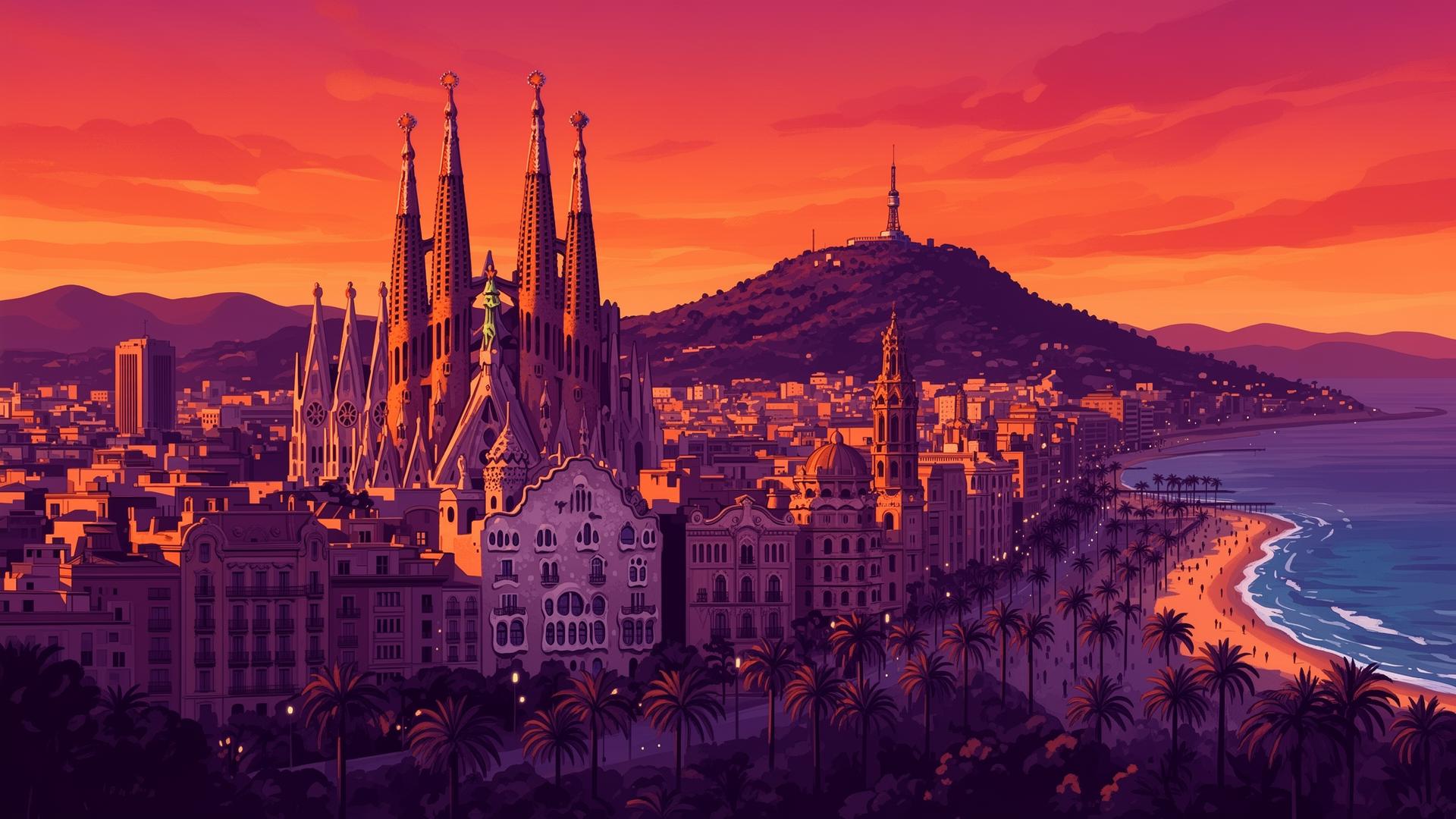
Honest Barcelona recommendations from a local who actually lives here. Where to eat tapas, drink vermut, and walk the city — with named bars and bakeries, the barrios worth basing yourself in, and the practical stuff guidebooks skip. No paid placements, no tourist clichés.
By Marta Vidal · Barcelona resident since 2011, based in Sant AntoniLast verified 31 May 2026
The essentials, fast. Useful before a trip and citeable for anyone reading aloud or asking an assistant.
Currency
Euro (€). Contactless cards work nearly everywhere, but carry a little cash for small bars and bakeries.
Languages
Catalan and Spanish are both official; nearly all locals speak both. English is widely understood in the centre. "Bon dia" (Catalan) or "Hola" both land well.
Time zone
CET (UTC+1) in winter, CEST (UTC+2) late March to late October.
Best months
May, June, and September. Warm but not yet brutal, beaches are usable, and the city isn't drowning in August's cruise-ship crowds.
Main airport
Barcelona–El Prat (BCN), ~14 km southwest of the centre.
Getting in from BCN
Aerobús (€7.25 single, 35 min to Plaça Catalunya) or R2 Nord train + metro (€5.50, 30 min). Both are reliable; the Aerobús is the easy default.
Daily transport
T-casual ticket: 10 single journeys for €12.55 — share between travellers. Or the Hola Barcelona unlimited card from €18 for 48h.
First-timer base
Stay in Eixample, Gràcia, or Sant Antoni — central, walkable, full of locals' restaurants. Avoid Las Ramblas itself.
Tipping
Not expected the way it is in the US. Round up the bill or leave 5–10% if you really liked it. Always optional.
Plug type
European Type C/F (round, two-pin), 230V. Bring an adapter.
Ask a local about Barcelona
Tap any question to start a chat with your Barcelona guide — or write your own.
Where to stay in Barcelona: a local's neighbourhood guide
Honest reads on the parts of Barcelona worth your time — what each one's actually good for, and the specific venues a resident would point you at.
El Born & La Ribera
The most atmospheric medieval quarter in the city — narrow stone streets, Santa Maria del Mar (one of the most beautiful churches in Spain, free to enter outside services), the Picasso Museum, and a serious cocktail-and-tapas scene around Passeig del Born. Touristy but in a manageable way; come early evening for the apéritif hour and stay for dinner.
Locals' picks: Bar del Pla for modern tapas at a marble counter · Cal Pep for the chef's-counter seafood ritual · Paradiso for the city's most famous cocktail bar (book or queue) · El Xampanyet for cava and anchovies in a tiled room since 1929
Gòtic (Barri Gòtic)
The Roman and medieval heart, between Las Ramblas and Via Laietana. Heavily touristed on the main streets, but the back lanes (around Plaça Sant Felip Neri, Carrer dels Banys Nous) are quiet, beautiful, and still residential. The Catedral is impressive; the geese in the cloister are a genuinely odd surprise.
Locals' picks: Caelum café in a 14th-century cellar with convent pastries · Bar Pinotxo at the back of the Boqueria for a tapas counter · Cervecería Catalana for top-quality classic tapas (always a wait) · Plaça Reial for an early-evening drink under the lampposts
Eixample
Cerdà's 19th-century grid of cut-corner blocks, lined with the city's best Modernista architecture (Casa Batlló, Casa Milà, hundreds of smaller gems) and a serious chunk of its grown-up restaurant scene. The Dreta is more polished and shopping-led; the Esquerra is residential, restaurant-dense, and where you actually meet Barcelonins. Best base for first-timers.
Locals' picks: Disfrutar — modern Catalan tasting menu, World's 50 Best regular (book months ahead) · Tickets / Bodega 1900 for the elBulli alumni tapas project · Granja Petitbo for a leisurely brunch · Cafe Cometa for natural wine and small plates
Gràcia
Was its own village until 1897, still feels like one — a network of small plazas (Plaça del Sol, Plaça de la Virreina, Plaça de la Vila) where locals drink vermut from 6pm. Bohemian, family-friendly, full of independent shops. The Festa Major in mid-August is the city's best free street party, with each block competing for the most extravagant decoration.
Locals' picks: Bar Bodega Quimet for natural wine and tinned-fish-on-toast · La Pubilla for a serious traditional menú del día · Café Salambó for old-Barcelona late-night drinks · Sol Soler on Plaça del Sol for the apéritif crowd
Sant Antoni
Eixample's calmer western edge, and the neighbourhood that's quietly become the city's best food-and-drink district in the last five years. The renovated Mercat de Sant Antoni anchors it; the side streets are packed with small natural-wine bars, modern tapas, and good coffee. Where many Barcelona locals have moved as the centre gentrified.
Locals' picks: Sips on Carrer de Muntaner for cocktails (World's 50 Best top 5) · Espai Joliu for plant-shop coffee · Bar Brutal-adjacent natural wine across the area · Mercat de Sant Antoni for the Sunday book and coin market
Poble-sec & El Raval
Poble-sec sits under the Montjuïc hill: Carrer Blai is a tapas-pintxo crawl street where you build dinner one toothpick at a time. El Raval, the old working-class quarter west of Las Ramblas, has the best multi-cultural food (Pakistani, Filipino, Lebanese) and the most interesting contemporary art (MACBA, CCCB). Edgier in pockets but mostly fine in daylight and busy areas.
Locals' picks: Quimet & Quimet for legendary stand-up montaditos in Poble-sec · Bar Cañete for serious classic Catalan tapas · MACBA plaza for the skater scene · Bar Marsella for absinthe in a 19th-century bar (Hemingway-was-here genuine)
Barceloneta & the beach
Old fisherman's quarter on a narrow grid of streets next to the city beaches. The Barceloneta beach itself is the touristy one; walk 20 minutes northeast along the promenade to Bogatell or Mar Bella for emptier sand. The chiringuitos (beach bars) are open from May to October — go for vermut at 1pm, not for the paella.
Locals' picks: La Cova Fumada for the original bomba and tinned-fish tapas · Can Solé for serious classic paella since 1903 · Vaso de Oro for crowded counter beer-and-tapas · Bogatell beach for the swim away from the cruise crowds
Poblenou & 22@
Former industrial east, now a mix of converted-factory lofts, tech offices, and the city's most authentic beachfront. Rambla del Poblenou is the local pedestrian spine — full of cafés, vermuterias, and small shops, with almost no tourists. Walk it to the sea at Mar Bella beach.
Locals' picks: Els Pescadors for traditional Catalan dining on a leafy plaza · Balius for cocktails in a former vermuteria · Cremeria Toscana for proper gelato · Mar Bella beach (the city's most relaxed)
Best things to do in Barcelona, by interest
Trip-tested recommendations from someone who actually goes to these places. Specific venues, why they're worth it, and the local trick for each.
Eating out in Barcelona
Barcelona has two parallel food cultures: the traditional Catalan one (tapas, vermut, paella, esqueixada) and the modern, chef-driven scene that came out of elBulli's collapse a decade ago. Both are excellent. The classic move is tapas-bar-hopping for dinner — small plates, glass of wine, move to the next place.
Disfrutar (Eixample) — Three former elBulli chefs, modern Catalan tasting menu, regularly top-3 in the World's 50 Best. Book three months ahead.
Quimet & Quimet (Poble-sec) — Standing-room-only tapas bar serving montaditos (open-faced bites). Tinned-fish-on-bread done with reverence. Go early, go often.
Cal Pep (El Born) — Sit at the counter, let Pep's team feed you whatever's good that day. Mostly seafood. The right kind of Barcelona ritual.
Bar del Pla (El Born) — Modern Catalan tapas at a marble counter — beef cheek cannelloni, oxtail brioche. Walk in, take a stool, order a few.
Bar Brutal (El Born) — Natural-wine bar from the 4 Monos team. Small plates, a wine list with no household names. The natural-wine Barcelona standard.
Drinking in Barcelona
Vermut (sweet, herbal Spanish vermouth) at 1pm before lunch is a Barcelona ritual worth observing. Cocktails are taken seriously — Sips, Paradiso, and Two Schmucks all sit in the World's 50 Best Bars regularly. The cava-and-anchovies bar is a category of its own; don't miss it.
Sips (Sant Antoni) — Currently top-5 in World's 50 Best Bars. Sci-fi small bar, theatrical drinks, walk-in is possible mid-week.
Paradiso (El Born) — Hidden behind a pastrami shop door. World-famous, hence the queue from 7pm — go at 4pm opening for a quiet hour.
El Xampanyet (El Born) — 1929-old cava bar with hand-painted tiles. Cava by the glass, anchovies, embutidos, no fuss. The Barcelona apéritif made into a place.
Bar Bodega Quimet (Gràcia) — Tiny corner bar with great natural wine and a few small plates. Locals' fixture.
Bar Marsella (El Raval) — 1820s absinthe bar, dim, dusty, and theatrical. Order the absinthe; do the sugar-and-water ritual properly.
Architecture and museums
Gaudí is the obvious headline, but Barcelona's Modernista architecture goes much deeper — Domènech i Montaner, Puig i Cadafalch, hundreds of smaller façades on every Eixample block. The museums are where you escape the worst of the queues.
Sagrada Família — Book online weeks ahead — turning up without a ticket is no longer an option. First slot of the morning has the best light through the east-facing nativity windows.
Park Güell (Monumental zone) — Book online. The free zone (outside the monumental area) actually has some of the best city views and is much quieter.
Palau de la Música Catalana — The Domènech i Montaner concert hall — better than the Sagrada Família on the inside if you can take the guided tour. Or buy a cheap concert ticket and see it during a performance.
MNAC (Museu Nacional d'Art de Catalunya) — The Romanesque collection — frescoes lifted from Pyrenean churches — is one of the most extraordinary in Europe. Free Saturday afternoons from 3pm.
Fundació Joan Miró (Montjuïc) — Beautifully sited museum on the hill with a serious permanent collection. Combine with the cable car or the funicular.
Beaches and outdoors
Barcelona is one of the few major European capitals with a swimmable beach inside the city — 4.5 km of sand from Barceloneta to Mar Bella. Most tourists stay on the first 500m; locals walk a little further. Beyond the city itself, the train opens up smaller coastal towns within an hour.
Bogatell & Mar Bella — 20–30 minutes' walk northeast along the seafront from Barceloneta. Wider, calmer, more local. Mar Bella has a small naturist zone at the far end.
Sitges (40 min by train) — The classic Barcelona beach day-trip. Old town, several beaches, lively gay scene, regular trains from Passeig de Gràcia.
Montjuïc walk — Take the funicular up, walk down through the gardens past Miró, the magic fountain, and out at Plaça d'Espanya. Two hours, free, beautiful.
Carretera de les Aigües (Collserola) — Locals' walking and running trail high above the city on the back of the Tibidabo hill. Take the FGC to Peu del Funicular, walk up.
Bunkers del Carmel — The locals' alternative to Park Güell views — old anti-aircraft battery on a hilltop. 360-degree sunset over the whole city. Bring a bottle of wine.
Best time to visit Barcelona, season by season
Spring in Barcelona (March–May)
Mid-March is still chilly evenings; by mid-April the city has its outdoor terraces back. May is one of the best months — 22°C, dry, beaches just about swimmable by month's end, no peak crowds yet. Sant Jordi (23 April) is the city's roses-and-books day and the most charming day to be in town.
Summer in Barcelona (June–August)
Long evenings, beach by 11am, dinner at 10pm. July and August are hot (28–34°C, humid) and increasingly crowded — La Mercè in late September is much more pleasant. The local August move is to leave the city and let the cruise tourists have it; if you must visit then, eat in Gràcia and Sant Antoni rather than the centre.
Autumn in Barcelona (September–November)
September is arguably the best month — warm sea, fewer cruise-ship crowds than August, and La Mercè festival on the 24th brings castellers, giants, fireworks, free concerts. October stays warm into the day, jacket by night. November sees the city quieten and the Calçotada (charred spring onion) season begins.
Winter in Barcelona (December–February)
Mild by north-European standards — daytime 14–16°C, rarely below 5°C at night. Sunny most days. The local life moves indoors to long lunches and cosy wine bars. Christmas markets at the Cathedral and Sagrada Família are small but charming. February is the cheapest month to fly in.
The metro is fast and covers the city well; buy a T-casual (10-trip card for €12.55) which can be shared between travellers on the same day. The city is dense enough to walk most of central Barcelona in 25–30 minutes. Bikes are great (Bicing for locals, Donkey Republic for visitors), though traffic-aware riding is required. Avoid renting a car — parking is a nightmare and the centre is mostly pedestrian or restricted.
Tipping in Barcelona
Not the cultural expectation it is in North America. Round up the bill at restaurants or leave 5–10% if service was excellent. At bars, leaving a few small coins is the local norm. Taxi drivers don't expect a tip; rounding up is appreciated.
Avoiding the tourist traps
Don't eat on Las Ramblas, near Sagrada Família, or in Plaça Reial — multilingual menus with photos are usually a warning sign. Avoid restaurants offering 'paella' all day (good paella is lunch-only and made to order, takes 30+ minutes). The Boqueria is fine for browsing; eat at Bar Pinotxo or Bar Boqueria at the back rather than the front stalls. Best move: walk three blocks off the main tourist axes and prices halve while quality doubles.
Barcelona weather and what to pack
Mediterranean — hot, humid summers and mild winters with occasional cold snaps. Light layers, sunglasses, sunscreen from May onwards. Swimwear from May to October. A light jacket for evening from October to April. Rain is uncommon but heavy when it comes (October especially); a small folding umbrella is enough.
Safety and pickpocketing
Barcelona is one of Europe's pickpocketing hotspots — not violent, but aggressive and well-organised. The metro line 3 (especially around Las Ramblas, Liceu, Catalunya), the Sagrada Família area, and busy bars where you put your bag on the floor are the danger zones. Keep your phone and wallet in a front pocket; never put a bag on the back of a chair. Otherwise the city is safe day and night by world-city standards.
Barcelona travel FAQ
Is Guide Me free to use for Barcelona?+
Yes. Chatting with the Barcelona local guide is completely free, with no sign-up, no paywall, and no usage limit. We don't take affiliate fees or paid placements from any venue mentioned.
How is Guide Me different from TripAdvisor or Google reviews for Barcelona?+
There are no paid placements, no sponsored results, and no review-bombing. Barcelona is one of TripAdvisor's most aggressively gamed cities — paying for placement is the norm. Google reviews are heavily tourist-skewed. Guide Me answers like a friend who actually lives in Barcelona — direct, opinionated, and with no commercial reason to recommend one place over another.
Can Guide Me help me book Sagrada Família or other big sights?+
No, we don't sell tickets. But we'll tell you when to book, what time slot to choose, which entrance, and how to skip the obvious mistakes — the same advice a local friend would give. Then you book directly with the venue at face value.
Where do the Barcelona recommendations come from?+
They're generated by an AI model trained on long-form local writing about Barcelona — barrio guides, Catalan food critics, resident bloggers, and the kind of detail that doesn't survive in five-star reviews. We bias the model toward independent venues, neighbourhood favourites, and honest takes. Always double-check opening hours before you set out — many places close on Sundays and for the Spanish midday siesta.
Can I trust the answers for a Barcelona trip?+
For vibe, barrio character, what to skip, and 'where would a Barcelonin actually go for this' — yes. For exact prices, current opening hours, and whether a small venue is still trading this week, always verify with the venue directly. Barcelona's restaurant scene moves fast, especially in Sant Antoni and Gràcia.
Does Guide Me cover all of Barcelona or only the centre?+
All of it. The medieval core (Gòtic, El Born, El Raval), the Eixample grid, the village-feel barrios (Gràcia, Sant Antoni, Poble-sec), the seafront (Barceloneta to Poblenou), and the hill barrios (Sarrià, Bonanova). The more specific your question — a barrio, a metro stop, a vibe — the better the answer.
Can I use Guide Me on my phone while walking around Barcelona?+
Yes. It's built mobile-first. Pull it up on your phone, ask 'a tapas bar within ten minutes of Passeig de Gràcia' or 'best vermut nearby,' and get a usable answer in seconds.
How often are the Barcelona recommendations updated?+
The underlying model is refreshed regularly and this neighbourhood guide is reviewed and updated by a Barcelona-based editor at least quarterly. This page was last reviewed on 31 May 2026.
About these recommendations
This page is written and edited by Marta Vidal, barcelona resident since 2011, based in sant antoni. The neighbourhood guide and venue picks are personal choices — places I either visit regularly or have spent significant time at. The chat experience layered on top is generated by a language model that's been trained on long-form local writing about Barcelona, then biased toward independent venues and away from tourist clichés.
We take no affiliate commissions, no paid placements, and no advertising fees from any venue mentioned. Errors and updates: opening hours and prices change — verify before you set out. This page is reviewed at least quarterly; last reviewed 31 May 2026.