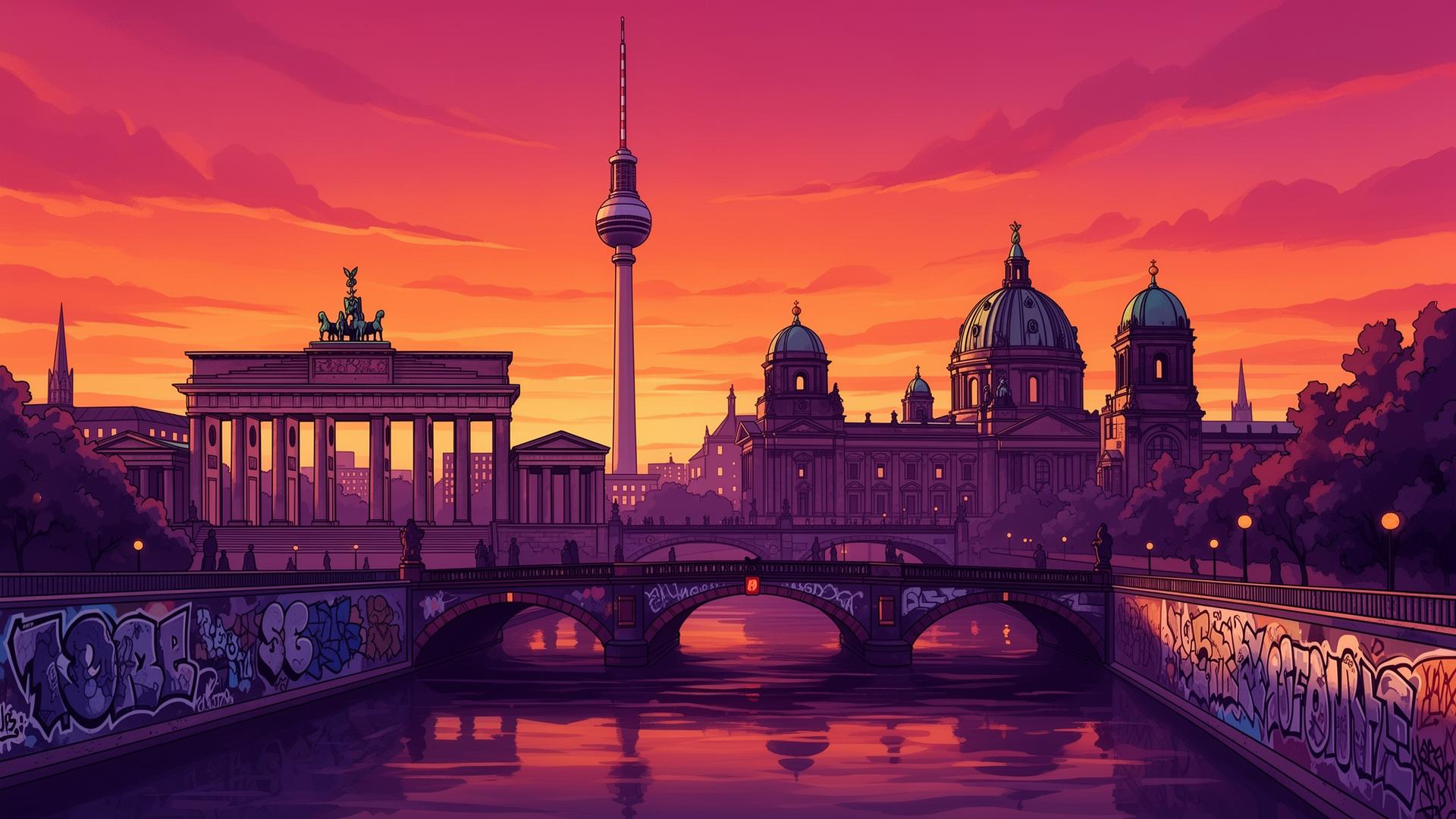
Honest Berlin recommendations from a local who actually lives here. Where to eat, drink, dance, and walk — with named venues, Kiez-by-Kiez detail, the club door etiquette nobody tells you, and the practical stuff guidebooks skip. No paid placements, no tourist clichés.
By Jonas Becker · Berlin resident since 2013, based in NeuköllnLast verified 31 May 2026
Where to stay in Berlin: a local's neighbourhood guide
Honest reads on the parts of Berlin worth your time — what each one's actually good for, and the specific venues a resident would point you at.
Kreuzberg (SO36 & 61)
Berlin's iconic Kiez — Turkish bakeries on Sonnenallee, Görlitzer Park's complicated weekday afternoons, Markthalle Neun for Street Food Thursday, and a club-and-bar scene that goes from techno bunkers to canal-side beer gardens. SO36 (east of Kottbusser Tor) is louder and rougher; 61 (around Bergmannstraße) is leafier and more residential. Both essential.
Locals' picks: Markthalle Neun on Thursday nights for Street Food Thursday · Burgermeister under the U-Bahn tracks at Schlesisches Tor · Möbel Olfe for queer-friendly drinks at Kottbusser Tor · Klunkerkranich, the rooftop bar above Neukölln Arcaden mall
Neukölln (north)
The Kiez most twenty- and thirty-somethings actually live in. Weserstraße and Weichselstraße are a chain of small bars from 7pm onwards. Tempelhofer Feld — the old airport runways now Berlin's biggest park — is a 10-minute walk south. Sunday breakfast on Hermannstraße or Schillerpromenade is the local move. Loud, multilingual, scruffy in the best way.
Locals' picks: Sing Blackbird for second-hand vinyl and Sunday brunch · Klunkerkranich for the rooftop sunset · Geist im Glas for cocktails in a candle-lit room · Tempelhofer Feld for cycling on the runway
Mitte & Friedrichstadt
The political and historical core — Brandenburg Gate, Reichstag, Museum Island, the Holocaust Memorial. Touristy and corporate in the daytime; the real Mitte is the back streets around Auguststraße and Torstraße (galleries, small bars, decent restaurants). Pair the museums with a long walk along the Spree.
Locals' picks: Museum Island (Pergamon, Neues, Bode) · Clärchens Ballhaus for old-Berlin dancing · Mein Haus am See for a 24-hour bar that locals actually use · KaDeWe food hall on the 6th floor for an absurd lunch
Friedrichshain
Former East, now the techno headquarters of Berlin. Berghain, Tresor, About Blank, ://about blank — most of the legendary clubs are within a 15-minute walk. By daylight it's a normal residential Kiez with Boxhagener Platz market on Saturdays and a strong Vietnamese restaurant scene. RAW-Gelände is the slightly more touristy late-night strip.
Locals' picks: Berghain (you know) · Briefmarken Weine for natural wine on Karl-Marx-Allee · Michelberger Hotel restaurant for a destination dinner · East Side Gallery for the Wall murals
Prenzlauer Berg
Once the bohemian East, now Berlin's most genteel Kiez — leafy streets, pram-friendly cafés, the Mauerpark flea market on Sundays. Calmer and more grown-up than Kreuzberg, with a string of good restaurants around Kollwitzplatz and Helmholtzplatz. Where you stay if you want Berlin without the 4am techno.
Locals' picks: Bonanza Coffee Roasters on Oderberger Str. · Mauerpark flea market and karaoke on Sundays · Konnopke's Imbiss under the U-Bahn for the original currywurst · Lucky Leek for serious vegan food
Schöneberg
Bowie and Iggy Pop's old neighbourhood, still the heart of queer Berlin (Motzstraße, Nollendorfplatz). Quieter than the eastern Kieze, with one of the city's best Saturday food markets at Wittenbergplatz and the Winterfeldtmarkt. KaDeWe department store is the daytime detour for the food halls upstairs.
Locals' picks: Winterfeldtmarkt on Wednesday and Saturday mornings · Café Einstein Stammhaus for old Vienna-style coffee house · Green Door for cocktails · Tom's Bar / Hafen for the queer scene
Charlottenburg
West Berlin's old centre, with a different character entirely — Schloss Charlottenburg, the Kurfürstendamm shopping strip, and a serious old-money restaurant scene around Savignyplatz. Mostly skipped by visitors, which is exactly why it's worth a half-day. Combine with the Berggruen Museum (Picasso) opposite the palace.
Locals' picks: Florian for classic Schwabian cooking near Savignyplatz · Cafe Bristol on Kurfürstendamm for a long lunch · Diener Tattersall for an old-Berlin late-night Kneipe · Sammlung Berggruen for serious 20th-century art
Wedding & Moabit
Northern Berlin, working-class, multilingual, and increasingly where artists priced out of Kreuzberg have moved. The Panke river towpath is a quiet 30-minute walk; the Beuth-Hochschule area has the city's best-value Turkish and Vietnamese food. You'll feel like a local because there are almost no other visitors.
Locals' picks: Café Pförtner inside an old bus depot · Hallesches Haus for design-y Sunday brunch · Maitre Philippe et Filles for French deli · Plötzensee outdoor lake-pool in summer
Best things to do in Berlin, by interest
Trip-tested recommendations from someone who actually goes to these places. Specific venues, why they're worth it, and the local trick for each.
Eating out in Berlin
Berlin's food scene is wildly cosmopolitan rather than traditionally German — the city's strength is its Turkish, Vietnamese, Lebanese, and Israeli kitchens. The German classics worth eating are the ones a local would actually order: a proper currywurst, a Schnitzel at a Kneipe, and a real döner from Sonnenallee, not the tourist queue.
Mustafa's Gemüse Kebap (Kreuzberg) — Famously the city's most-photographed döner, with the queue to match. The locals' alternative is Rüyam Gemüse Kebab in Schöneberg — same quality, no 90-minute wait.
Konnopke's Imbiss (Prenzlauer Berg) — Currywurst under the U-Bahn tracks, family-run since 1930. Eat standing up like everyone else.
Lode & Stijn (Kreuzberg) — Modern Dutch tasting menu, one of the city's smartest restaurants. Book ahead.
Markthalle Neun (Kreuzberg) — Thursday Street Food, Saturday farmers' market. The food halls Berliners actually use.
Coda (Neukölln) — Dessert-only Michelin-starred restaurant. Tasting menu of seven sweet courses paired with wines. Genuinely unlike anywhere else in Europe.
Drinking and clubbing in Berlin
Berlin's bar culture starts late and runs late. The Späti — corner shop with a few stools or a bench outside — is where evenings often begin. Clubs are a separate world: Berghain is the famous one, but the city has dozens of equally serious venues. Cash, no photos inside, and don't try too hard at the door.
Berghain / Panorama Bar (Friedrichshain) — The reference. Doors open Friday night, queue can be five hours, no photos inside, no shorts, no t-shirts with logos. Go late (3–5am Saturday) for better odds.
Sisyphos (Lichtenberg) — Outdoor-and-indoor club in an old dog-biscuit factory. Friendlier door, lake atmosphere, runs all weekend.
Buck and Breck (Mitte) — Tiny 14-seat cocktail bar behind an unmarked door. Reserve via Instagram, dress up a little.
Klunkerkranich (Neukölln) — Rooftop bar on top of a shopping mall. Sunset over the city, picnic vibe, cash-only.
Späti & beer in the park — Late-spring through early autumn, buy two Sterni or Beck's at any Späti for €1–1.50 each and drink them on a bench by a canal. The real Berlin.
Museums and history
Berlin's museums are unusually strong on 20th-century history — the city is essentially a 1.6-million-people open-air history lesson. The Museum Island Big Five and the Berlin Wall sites are the obvious must-dos; the smaller, more political museums are where the city's real conversation happens.
Pergamonmuseum (Museum Island) — Reconstructed ancient gates and altars on a scale you won't see elsewhere. Some wings closed for renovation — check before going.
Gedenkstätte Berliner Mauer (Bernauer Straße) — Free, open-air, the most honest Wall memorial in the city. A 1.5km strip of preserved death-strip and a viewing tower.
Jüdisches Museum (Kreuzberg) — Libeskind's zigzag building is part of the experience. Allow at least two hours.
Hamburger Bahnhof (Mitte) — Contemporary art in a former railway station. Beuys, Kiefer, Rauschenberg.
Stasi Museum (Lichtenberg) — The actual former Stasi HQ, kept as it was. Dense, dark, essential context for everything else in Berlin.
Walks, parks and lakes
Berlin is unusually green for a capital — 30% of the city is parks, forest, or water. The biggest gift is the lakes: a 30-minute S-Bahn ride out, you're swimming in a forest lake by lunchtime. Bring a towel, a book, and a Späti beer.
Tempelhofer Feld — Old airport runways, now a 300-hectare park. Cycle, skate, picnic, fly a kite. Sunset over the runways is iconic.
Mauerpark on a Sunday — Flea market in the morning, open-air karaoke from 3pm in the amphitheatre. Free, ridiculous, very Berlin.
Schlachtensee — Forest lake at the end of the S1 line. 30 minutes from the centre, swim-ready by May. The Strandbad Wannsee is the bigger, lido-style alternative.
Tiergarten central walk — Brandenburg Gate to the Siegessäule and on to Schloss Bellevue. An hour of central Berlin without traffic.
Spree to Oberbaumbrücke — Walk the Spree from Jannowitzbrücke to the Oberbaumbrücke, ending at the East Side Gallery and Holzmarkt for a Späti beer on the water.
Best time to visit Berlin, season by season
Spring in Berlin (March–May)
The city wakes up slowly — March is still grey and cold, but by mid-April the parks fill the moment a Späti table appears in the sun. May is one of the best months: 20°C, long evenings, lake water just about swimmable. Pack a light jacket. The Karneval der Kulturen at the end of May is the city's best free street party.
Summer in Berlin (June–August)
Long days (sunset at 9:30pm in June), open-air clubs running all weekend, lakes packed by 11am. Heatwaves can push 35°C with almost no aircon anywhere. August has the city at its most hedonistic — clubs go non-stop, the parks are full of barbecues, half the city is on a roof.
Autumn in Berlin (September–November)
September is the sweet spot — warm-ish, dry-ish, the city is back from holiday but the energy of summer hasn't faded. Berlin Art Week and the Festival of Lights make October a busy month for indoor culture. By November it's grey and dark by 5pm; this is the start of long indoor-bar season.
Winter in Berlin (December–February)
Cold (often below freezing), grey, dark by 4pm. The trade-off is real Christmas markets (the one at Gendarmenmarkt is touristy, the one at Charlottenburg Palace is the local favourite) and the city's indoor culture — clubs, bars, saunas — at its peak. Pack a proper coat, gloves, and hat. February is the cheapest month.
BVG runs U-Bahn (underground), S-Bahn (suburban), trams, and buses on one ticket. Buy a day pass (€10.60 for AB zones, which covers everything except the airport — that's an ABC ticket at €11.10) via the BVG app. The U-Bahn and S-Bahn run 24 hours on Friday and Saturday nights. Bikes are excellent and cheap (Nextbike, Lime, or rent for the day). Walk where you can — Berlin's neighbourhoods are flat and the city rewards it.
Cash and cards in Berlin
Berlin is famously behind on card payments. Many bars, Spätis, Imbisse, small restaurants, and even some doctors are cash-only or refuse cards under €10–20. Always carry €40–50 in cash. ATMs at Sparkasse, Postbank, or the Reisebank at major stations are fee-free or low-fee; avoid Euronet ATMs, which charge €4–6 per withdrawal.
Tipping in Berlin
5–10% in restaurants, round up at bars. The local etiquette is to tell the waiter the total amount including tip when they take your payment ("Zwanzig bitte" for €20 on an €18 bill), rather than leaving coins on the table after. Card payments often include a tip prompt now too.
Club door etiquette
Most serious clubs (Berghain, About Blank, Sisyphos, KitKat) have selective doors. Don't queue in a big group — pairs and singles get in more easily. No phones out near the bouncer. Don't dress flashy; dark, simple clothes work. Speaking some German doesn't help, looking like you've been there before does. If you're turned away, just walk to the next venue — it's normal, not personal.
Safety
Berlin is safe by major-city standards day and night. The main thing to watch is pickpocketing on the U-Bahn and around tourist spots (Alexanderplatz, Brandenburg Gate, Warschauer Straße at night). Görlitzer Park has a drug dealing scene most locals just walk past — uncomfortable rather than dangerous, but worth knowing. Late-night around major train stations, normal city instincts apply.
Berlin travel FAQ
Is Guide Me free to use for Berlin?+
Yes. Chatting with the Berlin local guide is completely free, with no sign-up, no paywall, and no usage limit. We don't take affiliate fees or paid placements from any venue mentioned.
How is Guide Me different from TripAdvisor or Google reviews for Berlin?+
There are no paid placements, no sponsored results, and no review-bombing. TripAdvisor's Berlin ranking is dominated by venues optimised for tourists; Google reviews skew toward the most-photographed places. Guide Me answers like a friend who actually lives in Berlin — direct, opinionated, and with no commercial reason to recommend one place over another.
Can Guide Me help me get into Berghain or other clubs?+
It can tell you what locals actually do — when to arrive, how to dress, what to say (and not say), and which alternative clubs to try if you're turned away. The door is famously unpredictable; nobody can guarantee entry, but going at 3–5am on Saturday with a small group and a low profile is the playbook.
Where do the Berlin recommendations come from?+
They're generated by an AI model trained on long-form local writing about Berlin — Kiez guides, German food critics, resident bloggers, and the kind of detail that doesn't survive in five-star reviews. We bias the model toward independent venues, neighbourhood favourites, and honest takes. Treat answers as a strong starting point; always double-check opening hours before you set out.
Can I trust the answers for a Berlin trip?+
For vibe, Kiez character, what to skip, and 'where would a Berliner actually go for this' — yes. For exact prices, current opening hours, and whether a small venue is still trading this week, always verify with the venue directly. Berlin's bar and restaurant scene moves fast.
Does Guide Me cover all of Berlin or only the centre?+
All of it. Mitte and Friedrichstadt, the inner east (Kreuzberg, Neukölln, Friedrichshain, Prenzlauer Berg), the inner west (Schöneberg, Charlottenburg), and the outer Kieze (Wedding, Lichtenberg, Treptow). The more specific your question — a Kiez, a U-Bahn stop, a vibe — the better the answer.
Can I use Guide Me on my phone while walking around Berlin?+
Yes. It's built mobile-first. Pull it up on your phone, ask 'what's a good Späti near Kottbusser Tor' or 'a quiet bar within ten minutes of where I am,' and get a usable answer in seconds.
How often are the Berlin recommendations updated?+
The underlying model is refreshed regularly and this neighbourhood guide is reviewed and updated by a Berlin-based editor at least quarterly. This page was last reviewed on 31 May 2026.
About these recommendations
This page is written and edited by Jonas Becker, berlin resident since 2013, based in neukölln. The neighbourhood guide and venue picks are personal choices — places I either visit regularly or have spent significant time at. The chat experience layered on top is generated by a language model that's been trained on long-form local writing about Berlin, then biased toward independent venues and away from tourist clichés.
We take no affiliate commissions, no paid placements, and no advertising fees from any venue mentioned. Errors and updates: opening hours and prices change — verify before you set out. This page is reviewed at least quarterly; last reviewed 31 May 2026.